it-sa 2026: Using LLMs to Create Secure Software
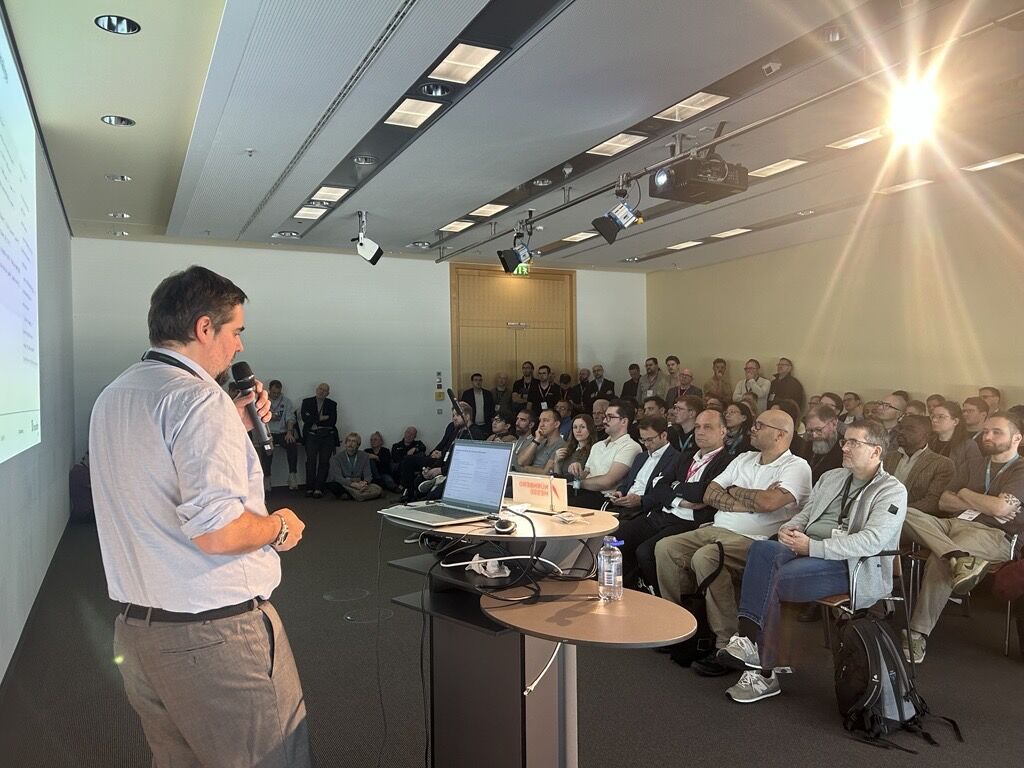 At this year’s it-sa Expo&Congress in Nürnberg I gave a talk on how large language models can support secure software engineering — finding vulnerabilities and privacy risks early, for instance when analysing Android apps. The session was part of the Bitkom programme in the Congress@it-sa track.
The talk also traced the history of AI-supported vulnerability detection: from deep learning models trained on labelled examples around 2018, through prompt-based approaches after ChatGPT and knowledge-augmented prompting, to today’s agent systems that find, prove and patch vulnerabilities.
My colleagues from ATHENE, the largest centre for applied cybersecurity research in Europe, were at it-sa as well, showing their projects on cybersecurity research.
Many thanks to Felix Kuhlenkamp and Bitkom for the invitation.
Now in Secure Software Engineering
I now work in the Secure Software Engineering department at Fraunhofer SIT, which is led by Steven Arzt. My focus there is finding privacy-relevant data in apps — where an app collects or passes on personal data, and how large language models can help to spot such privacy risks early.
Bitkom AK Artificial Intelligence & Informationssicherheit
In May 2025 I gave a talk “Angriffe auf aktuelle LLM und wie man sie absichern kann” at the meeting of the Bitkom working group Artificial Intelligence & Information Security at the BOSCH IT Campus in Stuttgart.
The talk focused on jailbreaks, how current LLMs are pushed past their safeguards, and presented recent approaches from the literature, from manually crafted and role-play prompts to automated, adaptive attacks that keep querying the model. It closed with what operators of their own models can do about it.
AI at ATHENE at Count+Care
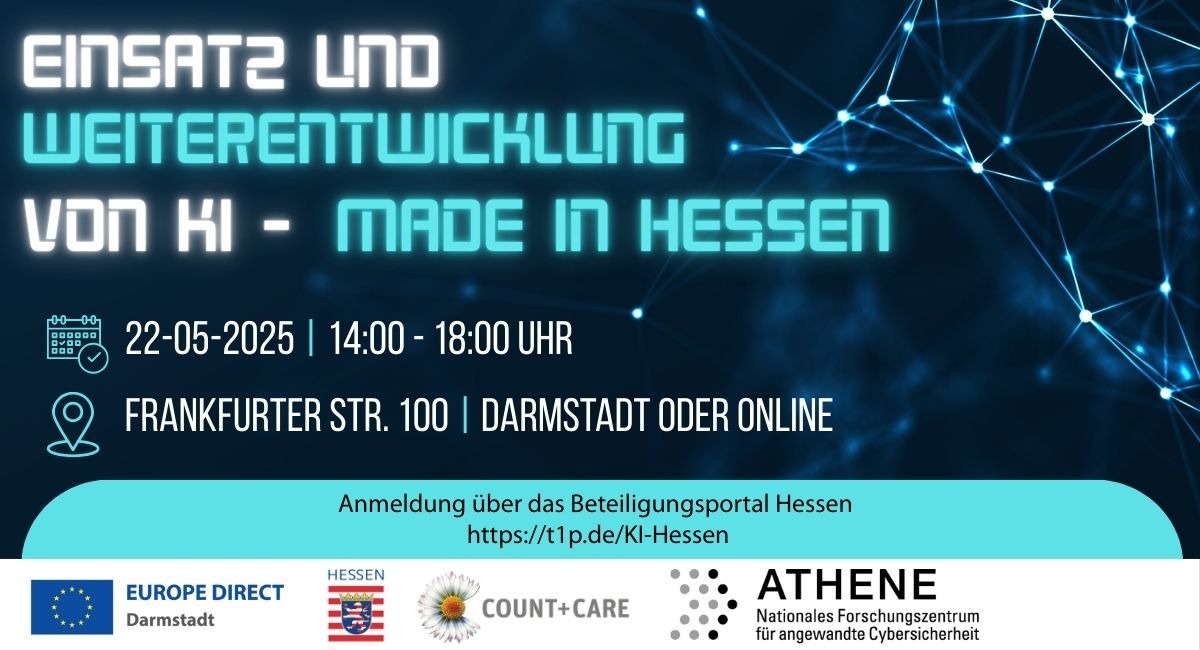 In May 2025 I spoke at the joint event “Einsatz und Weiterentwicklung von KI – made in Hessen” of Europe Direct Darmstadt, ATHENE, Count+Care and the Hessian State Chancellery, giving a talk titled “KI von ATHENE: KI-Innovationen zur Absicherung der digitalen Welt”. The event was aimed at a general audience and combined short talks with an interactive exhibition of AI demonstrations.
The talk gave an overview of how ATHENE uses AI to secure digital systems, with examples from our own work: SuSi and CoDoC, which learn to recognise potentially sensitive functions in Android apps and thereby uncover data leaks that classic scanners miss. Visual age estimation, the topic I worked on before, for applications ranging from youth protection to identity verification. And the KIKu project, which helps customs and investigators identify illegally traded archaeological objects.
New job at Fraunhofer SIT
 I am very proud to be part of the Fraunhofer SIT. I started in the AI and Security department working on the identification of harmful and abusive material, and I have since moved on to the Secure Software Engineering department led by Steven Arzt, where I now work on finding privacy-relevant data in apps. This remains a journey for me and I am still looking forward to learning new things — in particular, I work a lot more with program analysis and computer vision than ever before.
ECML Test-of-Time Award!
 This year, the Award Chairs of ECML PKDD 2024 reviewed the best publications from the 2014 conference for the prestigious Test-of-Time Award, recognizing exceptional papers that remain impactful a decade after their publication.
I’m pleased to share that our paper, “Large-scale multi-label text classification—revisiting neural networks” (pdf), co-authored by Jinseok Nam, Jungi Kim, Johannes Fürnkranz, Iryna Gurevych, and myself, has been awarded the Test-of-Time Award at the ECML PKDD 2024 conference.
This is a great recognition of our team’s efforts, and I’d like to particularly acknowledge Jinseok for delivering another excellent presentation on this work during the conference in Vilnius.
 When we first published this in 2014, neural networks were not yet the state-of-the-art for large-scale text classification. In this paper, we addressed limitations of existing methods and introduced techniques like rectified linear units (ReLU), dropout, AdaGrad, and the now-standard cross-entropy error function, which has become foundational in this field. We believe our research laid the groundwork for many later studies on neural networks in text classification.
It’s an honor to receive this award and see the continued impact of our work!
Read the story also on LinkedIn.
A new homepage
The website has been rebuilt: more content, a new design and a new technical foundation — at the same address, research.eneldo.net.
Publications, projects, teaching material and resources now sit in one place. The publication list is generated from a BibTeX database instead of a hand-kept list, and the news, project and publication pages share one layout, so they no longer drift apart.